Category: Uncategorized (Page 4 of 9)

The R.A. Doughton Bridge

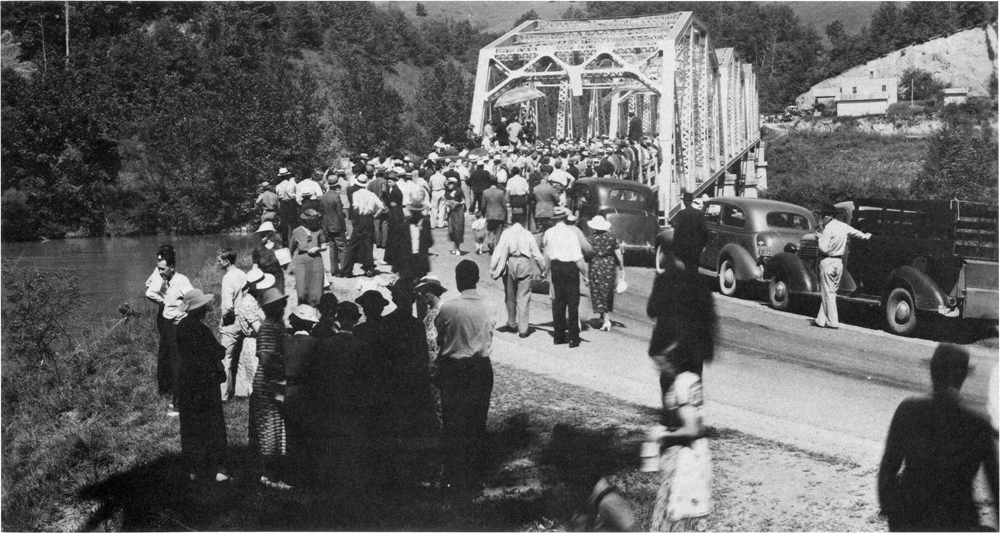
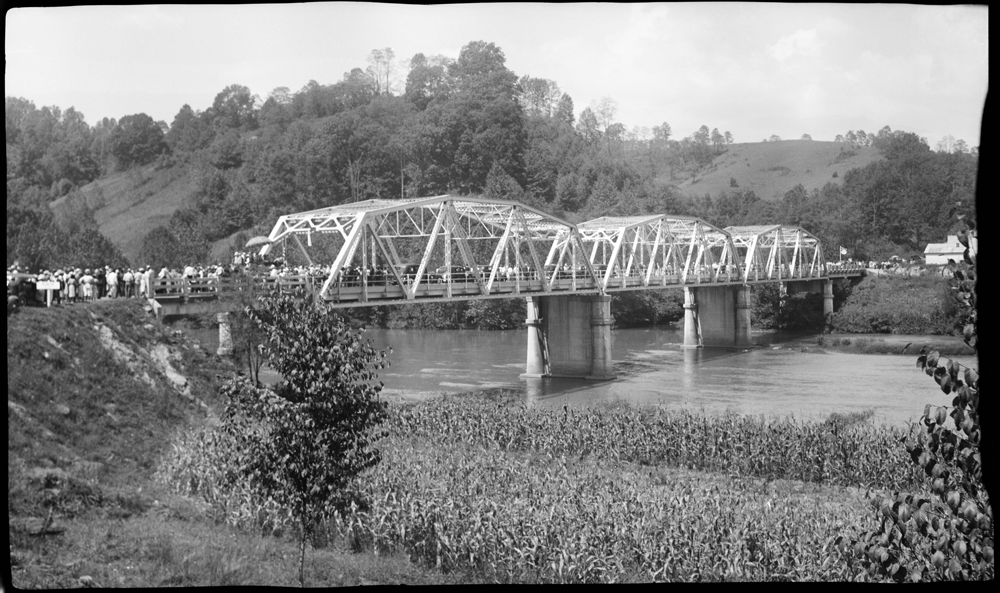
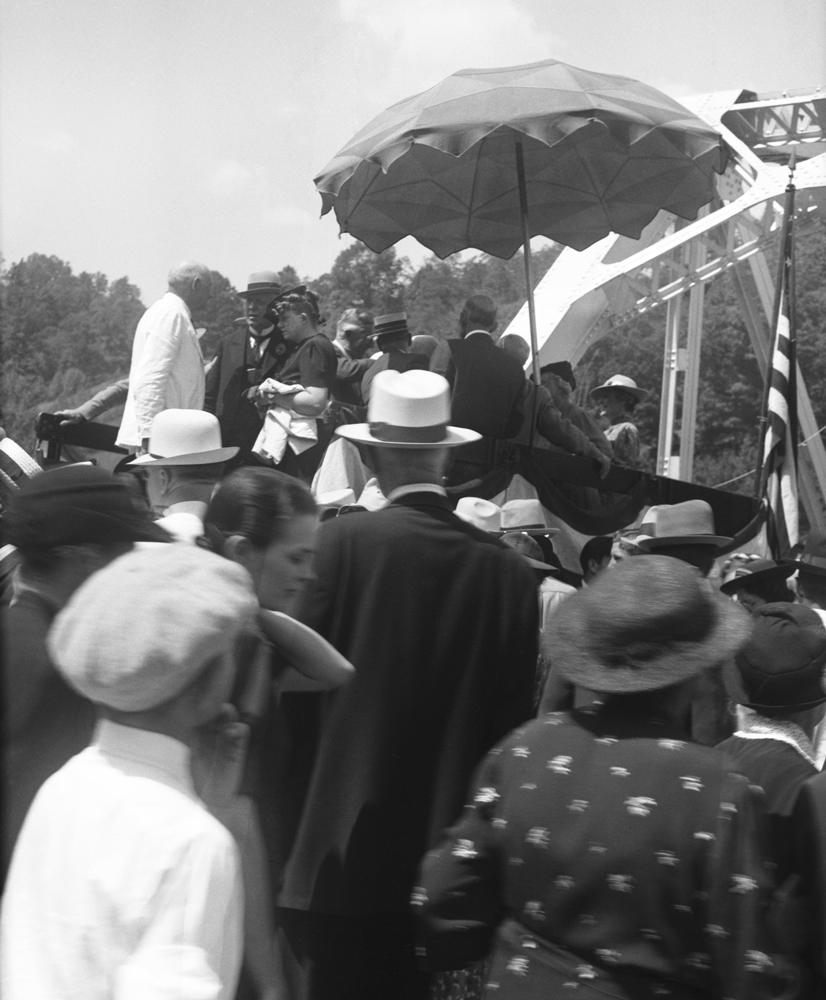
Text from this post is an article from the September 6, 1938 edition of the Bristol News Bulletin about the dedication of the R.A. Doughton Bridge on US Highway 21, just south of Independence in Virginia. At the event, officials unveiled a bronze plaque, commemorating Lt. Governor Doughton who was former head of the NC highway commission. The plaque was removed when the bridge was torn down and replaced in 1989. It is now in the Alleghany Historical Museum, donated by the Woodruff family.

Big Crowd At Road Program

Bridge over New River is Dedicated to Rep. Doughton, Carolina

Prominent local attorney, and brother of Bob Doughton, Rufus Doughton was elected to the NC House of Representatives in 1887. He subsequently served in 1889, 1891, 1903, 1907, 1909, 1911, 1913, 1915, 1917, 1919, 1921, 1923, and 1933. In 1891 he was chosen Speaker of the House and in 1892 was elected NC Lieutenant Governor, serving in that capacity from 1893 to 1897.
(Photo from History of Alleghany County 1859-1976)

WYTHEVILLE, Va. Sept. 6 (AP)—
Virginia, West Virginia and North Carolina joined hands yesterday morning at the dedication of Doughton Memorial Bridge over New River near Independence and again yesterday afternoon at a barbecue and celebration of the recent completion of a link in the Lakes-to-Florida highway. The new stretch of hard-surfaced road joins Wytheville and Independence.

Some 2,000 persons attended the exercises at the bridge when the span, located in Virginia a few hundred yards from the North Carolina line, was dedicated to R. A. Doughton, former chairman of the North Carolina highway commission and former lieutenant-governor of that state.

Governor Clyde Hoey of North Carolina, in praising Doughton, said it is a “unique fact that the bridge was built in Virginia with the aid of North Carolina funds and that the span was being named for a North Carolinian.” North Carolina contributed half of the $100,000 spent in construction of the bridge.

Commenting on the friendship which exists between Virginia and North Carolina and on the administration of governmental affairs of the two states, Hoey suggested that “others come to Virginia and North Carolina to see how a government ought to be run and how the people ought to be served.”
Former Governor Trinkle Speaks

Former Governor E. Lee Trinkle, of Roanoke, who dedicated the bridge, praised Virginians, West Virginians and North Carolinians who have worked for completion of route 21 in Grayson and Wythe counties for some 15 years.

A bronze marker at the south entrance to the bridge on which was inscribed the following:

Dedicated to R.A. Doughton
Built in 1927

In his response to the dedicatory speech, Doughton said, “I regard this as the greatest moment of my life and I want to thank the Virginians who made this bridge possible.” The structure was built in 1927 but its dedication was postponed until the road between here and Independence was hard-surfaced.

Original plaque from the bridge which was built in 1927, dedicated in 1938 and replaced in 1989.
Donated to Alleghany Historical Museum by the Woodruff family.
Continue reading

Nora Caudill Wagoner – Oldest WWI Red Cross Nurse

Sept. 5, 1982 – Article from the Chronicle-Tribune
in Marion, Indiana

Nora Caudill Wagoner, until her death this February at 99 years of age, was America’s oldest Red Cross Volunteer on record in the United States. She graduated from the Marion Hospital nursing school in 1905.

Mrs, Wagoner in 1979, just before her 97th birthday holding a framed photo of her 1905 graduating class at Marion Hospital in Marion, Indiana.
Clipping from the February 15, 1982 edition of the Raleigh News and Observer.

Shortly before Mrs. Wagoner’s death, her daughter, Mrs. Elvira Crouse, wrote the Chronicle-Tribune and asked if the city would be interested in hearing the story of this pioneer nurse who got her start in Marion.

She furnished us with photographs her mother, kept over the years and the story of Nora Wagoner – one of the earliest professional nurses.

By Celeste Williams

Nora Caudill was born Dec. 17, 1882, the fifth of 12 children, in Alleghany County on Air Bellows Mountain, North Carolina, an energetic girl with a dream to travel.

She would often visit relatives who lived in Marion, Indiana. And it was on one of these visits that she saw a woman in a starched white apron and hat tend to a patient in the home of a friend. And right then she decided to become a nurse.

“I admired her uniform and her cap,” she recalled, “I thought she was just wonderful.”

At the time of Nora’s birth, a woman named Clara Barton was organizing nurses into the American Red Cross. And nursing was just coming into its own by the time Nora decided she wanted this to be her profession.

Hospitals were a new phenomenon in the late 19th and early 20th centuries, and they were few and far between. So were schools to educate nurses, and so were working women.

But the first Marion Hospital, with a capacity of 20 patients, was opened in 1896, on S. Washington Street, and was owned and operated by Dr. T. C. Kimball.

Miss Caudill and others on the steps of the Marion Hospital, sometime before 1905.
The hospital opened in this frame house in the late 1800s. The 20-patient hospital’s nurses training program was organized in 1902.

Nora Caudill stood tall for a photographer in 1905 with nine other nurses and Dr. Sam Davis (great-uncle of Dr. Joseph B. Davis, Marion), for a graduation class portrait.

In this portrait of the 1905 Marion Hospital graduating class, Nora is standing directly behind
Dr. Sam Davis, seated, center front.

The women, hands folded in their laps and short smiles on their pursed lips, were dressed in the traditional starched uniforms – striped blouses with high, stiff white collars, long white aprons and white hats perched atop long hair pulled back into buns.

Nora Mae Caudill – 1904

Nora finally achieved her goal — what was to come next?

“There were few hospitals anywhere in the nation,” she later recalled, so she remained in Marion for a time as a private duty nurse for wealthy families and professionals, she said.

Nora was about as eager to travel as she was to become a nurse. So she left Marion with her diploma, her medical supplies in a little leather bag, and an urge to travel. She carried with her no worries about what people would say about a young unmarried woman traveling alone.

“I had a desire to see the country,” she said. “So I would stay in one state maybe two or three years then move to another.”

So, for 15 years, Nora rode the trains of the United Slates as what she called a “tramp nurse.” She saw Indiana, Montana, Washington, Idaho, South Dakota, West Virginia, Virginia, Kentucky and North Carolina.

“I made a habit or wearing my Red Cross pin and in my travels I was approached many times by people needing help,” she said. “Once in Chicago, a railroad conductor saw my pin and asked if I would get off the train and help in an emergency. I stayed there for a week before continuing my trip.”

Nora Mae Caudill
Alleghany native and, for a time, the oldest living Red Cross nurse from World War I.
Continue reading

Rebecca Moon Entrusts Mega Research Site to AHGS

If you’ve ever encountered a site called moonztuff.com, you’re already familiar with this immense (invaluable, accessible, comprehensive, etc.) genealogical resource. If you’ve not yet visited in the 20 years it’s been online and you’re interested in Alleghany County history, you really should take a look.

The site is called, The Cheek Family of Alleghany County, North Carolina, and it covers that family’s history well. But, it also includes info on 135 other surnames that historically interact with the family.
It, also (!), includes the subsite, Deed Abstracts of Alleghany County, NC with a list that begins in the 1700s, before Alleghany County existed, and ends in 1880.
It’s searchable by date or by a surname index. You’ll also find a list of land grants, there.

Incredibly, the site also includes Rebecca’s excellent resource,

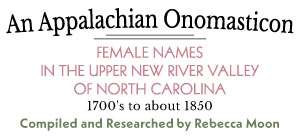
An Appalachian Onomasticon
Female Names in the Upper New River Valley of North Carolina
1700’S to about 1850.

This huge list of female, “given names” was taken from Alleghany’s early deed abstracts, and (in what must have taken countless hours) extracted, researched and recorded here.

Find photos, maps, documents and much more at the site. We appreciate Rebecca’s work in researching and assembling this wonderful resource!
And we thank her for sending it to us!

John Carteret – Land “Lord”

John Carteret, 2nd Earl Granville, commonly known by the title,
Lord Carteret.

“North Carolina was a proprietary colony originally, with eight ‘Lords Proprietor’ owning the land from 1663 to 1729. In 1729, seven of those eight lords were persuaded to sell their land back to the English Crown. The eighth Lord Proprietor at that time was John Carteret, Baron Carteret of Hawnes in the County of Bedford; and he refused to sell his share back to the Crown, although he never visited his land in North Carolina during the course of his lifetime.

“Originally, he was entitled to one tract of land in NC, a second tract of land in SC, and yet another in GA (all of which were originally part of ‘Carolina’). Samuel Warner, a London surveyor, was hired to calculate the size that one continuous tract would be, and he determined that Carteret’s one-eighth share should be from the northern boundary the current VA/NC line (36 degrees 30 minutes), and the southern boundary, 35 degrees 34 minutes.  In 1743 the initial boundary line was surveyed by a commission.  The line was extended westward in 1746, and again in 1753. The sixty-mile-wide tract of land was to extend from the Atlantic to the Pacific Ocean. [actually it’s a little over 64 miles. Emphasis added– Ed.] 

The Granville District- shown extending to the Pacific Ocean
Continue reading

Absolom and Agnes Smith – Alleghany Pioneers

The place now called Roaring Gap in Alleghany County, North Carolina, along the Eastern Continental Divide is named so because it lies between two peaks of the Blue Ridge that dramatically amplify the sound of the wind.

A few white travelers had found their way into the area by the time of the American Revolution. And the Blue Ridge was a good hide-out for Tories after the war, as the forest was full of elk, deer, buffalo, bear, wild turkeys, and other game.

Agnes Maynard was the daughter of William Maynard (1720-1816) who was originally from England but had emigrated to Norfolk, Virginia, around 1736.

Absolom Smith was also originally from England. He had come to Virginia in search of a better life and was working there, in bondage to Mr. Maynard. Absolom had planned to work out the required seven years of servitude and then make his own way in the New World. But before that time was up, Absolom and Agnes found they had fallen in love.

The couple knew that her parents would never agree to a marriage between their daughter and an indentured servant. So, around November of 1800, they took their belongings, a horse and a slave, and eloped to the North Carolina mountains, where the authority of the law did not extend at that time.

Absolom and Agnes were married somewhere along the way. There exists a record of an Absalom Smith marrying Agnes Manord November 27, 1800, in Wake County, North Carolina. (William Mainord died February 22, 1816, in Wake County. His will, dated February 2, mentions a daughter, Aggy Smith. https://www.wikitree.com/wiki/Maynard-321)

They were chased by Indians near the Yadkin, but narrowly escaped by fording the river. Agnes rode the horse. Absolom could swim, but the slave could not and held onto the tail of the horse in the crossing. Somehow, they managed to make it to the other shore and to safety.

Just outside of what is now Elkin, the couple passed the last settler’s cabin and headed into the real wilderness. They climbed the mountain and when they arrived at the top of the escarpment, at “a good spring,” they decided to settle there. Family tradition says they lived in a large hollowed-out log until they could build a cabin. It was too cold to cut timber or build, but as soon as they could, they did.

Their home was located on Alleghany Heights, in what is now the High Meadows development at Roaring Gap.

From passing white hunters and Indians, they learned, there were people living in Mulberry Field (now Wilkesboro) and that one or two families lived near the present site of Jefferson. These, and the family at Elkin, were their closest neighbors.

This hardy couple survived. They built their cabin and had children who were “hard-working, thrifty, and resourceful.” Absolom and Agnes were buried in their apple orchard, but when the development was built, their remains were moved to the Antioch United Methodist Church Cemetery, nearby.

Antioch United Methodist Church in Roaring Gap, North Carolina
©2009 Jeff Halsey

Their grave (https://www.findagrave.com/memorial/89352036/absolom-smith) is simply marked:
Absolom Smith
Agnes Maynard Smith
Pioneers
17- – 18 – –

Added by:  Coy O. York at Find-a-Grave

Information from the book Alleghany County Heritage and from
the late Pauline Swisher Meals whose grandfather, Rev. James Ralph Smith’s, farm was located at the present site of Lake Louise.

“Farmer Bob” Talks To Home Folks At Dedication of County Office Building

Robert L. Doughton speaks at the dedication of the Allegahny Community Building in 1941.
Photo by Carl Irwin.

Article from the May 8, 1941 edition of the Alleghany News.

Last Saturday Congressman Robert L. Doughton, chairman of the House ways and means committee, came to Sparta to help dedicate the new County Office building, recently completed as a WPA project, and to address his Alleghany home folks in an appeal for all possible aid to Britain.

Congressman Doughton lauded the work and the efficiency of the WPA and said regarding it,- “This building is a monument to what WPA has been doing. The farmers have been freed from isolation by the roads over which also the children can go to school, the mail can be delivered and the farmers can get to and from market. We have hundreds of new schools in the state, miles of water and sewer lines. What you have seen in Alleghany County has been done in every county in the state, in every county in the nation.”

Congressman Doughton related that. $11,000,000 had been spent in his congressional district; that the waste had been insignificant. He was satisfied with the report of accomplishments which he had requested from State WPA Administrator C.C. McGinnis, whom he lauded as a great public servant.

Regarding world affairs Congressman Doughton said, “We are faced with the greatest crisis in our history. We are in an inevitable emergency brought on by no fault of our own. The American people are beginning to awaken to the seriousness of the situation. With our people waked up, there is no task too great for them to meet.”

“Britain is our only ally and friend,” he continued. “She is fighting with her back to the wall. Help Britain as far as we can. Everybody is behind it. We are a nation above politics. Willkie, Knox and Stimson are walking hand and hand. As a nation, we have risen
above party lines.”

“England will go down without our wholehearted support. There is no question as to the intent of the diabolical, fiendish dictators. They are trying to make the rest of the world and us their bond slaves. England is fighting to preserve our way of life for herself and for us. The United States is confronted with that same danger.”

“Realize it right now, we must protect ourselves. We will have to pay more taxes. We will have to sacrifice for our country. Our people are united and they are ready to sacrifice. This is a dark, solemn hour. We will not fail to prepare and to make the sacrifices necessary to meet the emergencies.”

Chairman of the Alleghany county board of commissioners, Victor Phipps, accepted the structure in behalf of the county. The Hickory High School Band furnished the music for the occasion. Mentioned for great credit were Clyde Crutchfield, WPA district manager of North Wilkesboro, and Claude Mikes, WPA supervisor for Alleghany county. Reverend R.L. Berry gave the invocation, while Rev. L.F. Strader pronounced the benediction.

The ceremonies were held on an especially constructed platform in front of thee new building. In front of that, the crowd assembled to listen and pay honor to their distinguished congressman.

The gala occasion wound up with a dance in the new assembly hall of the WPA-built native stone structure.


The Alleghany Courthouse Annex, named for Judge Richard Doughton.

Ima Smith’s WWII Scrap Book

We’ve recently scanned a scrap book of men and women from Alleghany County who served in World War II. The book belonged to Ima Smith of Cherry Lane and features news clippings about approximately 150 people.

Download a pdf, here.

The images are a little rough, at 80 years old, but the text is readable and the information is priceless. Clippings came from the Alleghany News and other local newspapers.

Page from Ima Smith’s WWII Scrap Book.

The Alleghany News has been a good partner and supporter of the Historical Museum since it began. The scrapbook was donated to the Museum by Ima Smith.

Armistice Day 2021

L-to-R- James Alley, Andrew Higgins and William Weaver. Three Alleghany men who died in 1918 while serving in France during the First World War.

World War I officially ended when the Treaty of Versailles was signed on June 28, 1919. However, fighting had ceased seven months earlier when an armistice, or temporary cessation of hostilities, between the Allied nations and Germany went into effect on the eleventh hour of the eleventh day of the eleventh month.
Armistice Day was primarily a day set aside to honor veterans of World War I, but in 1954 the 83rd Congress amended the Act of 1938 by striking out the word “Armistice” and inserting in its place the word “Veterans.” With this legislation, November 11th became a day to honor American veterans of all wars.

Info from the US Dept. of Veterans Affairs

From the U.S. Army Center of Military History website

Interesting Observations of Life in Alleghany

In 2007, Professor Susan E. Keefe of the Department of Anthropology at Appalachian State University led an ethnographic field school in Alleghany County. An ethnographic field school allows students to use the techniques of the anthropologist (principally participant observation and interviewing) in order to describe and understand the meaning of a people’s way of life. Students in the field school were placed with host families with whom they lived for four weeks. For the most part, students learned by living and talking to members of their host family, the family’s relatives, their friends, and their neighbors.

The research papers in the collection were produced by six students in the field school. While each paper investigates only a single aspect of life there, the collection as a whole gives insight into the culture of this rural Appalachian county.

Alleghany County lies in the northwestern corner of North Carolina. It has one of the smallest populations of any county in the state (9,591 in 1990), and the county seat, Sparta (population 1,957), is the only town in the county. The economy is based on agriculture, manufacturing, and tourism. The Blue Ridge Parkway winds along the southern boundary of the county, introducing tourists since the 1930s to the natural beauty of the area.

Information from the Preface


Please, Don’t Tread on Me: A Case Study of a Dairy Farm in the Appalachian South
-Amer Awad

The Effect of the Blue Ridge Parkway on Appalachian Farmers
-Shawna Chesto

Women’s Work in Alleghany County, NC
-Heidi M. Efird

Identity in a Mountain Family
-Kathryn L. Staley

It’s All Legal Until You Get Caught: Moonshining in the Southern Appalachians
-Jason Sumich

Making and Marketing Baskets: A Case Study of Basket Makers in Alleghany County, NC
-Miyuki Honda

Old World meets the New

This Spanish coin made its way from Mexico City to Alleghany County and
the banks of the New River, around 265 years ago.

Spanish Coin from 1756 on Display at Alleghany Historical MuseumThis silver, Half Reale coin, minted 265(!) years ago in Mexico City was traded and worn by one of the last of the indigenous people before white settlers appeared in force on the Blue Ridge. It was drilled to be worn on a necklace or some other type of adornment, and it is very rare- likely, the first of its kind to be found in Alleghany County.

The milled coin measures just under 3/4 of an inch in diameter. It was minted during the reign of Spanish King Ferdinand VI, and features a coat of arms with two lions and two castles, a classic symbol of Spain. The inscription, VTRA QUE VNUM means, “Both are one.” It appears around a crown over two hemispheres linking the Old and New Worlds together.Information from CoinQuest.comhttps://coinquest.com/cgi-bin/cq/coins.pl

A Successful Grand Re-Opening

Thanks to everyone who helped with our Grand Re-Opening, today! We had a good turnout, some good donations and (most important) a good time.Special thanks to Mason Wagoner, Karen Bell, Eileen Elrod, Martha Adams, Karlie Keepfer, Mayor Wes Brinegar and everyone who participated!

Eileen Elrod demonstrates spinning at the Alleghany Historical Museum, Saturday.
Continue reading

Museum’s Grand Opening

The Grand Opening of the Alleghany Historical Museum, at the First Community Building (45 North Main Street), will be August 20 & 21.

Friday night at 7pm on the 20th, we’ll have a Grand Opening Preview, where donors can see the exhibit and the lovely new Streetscape in downtown Sparta. If you’re interested in coming to the Preview, but haven’t donated before, the donation box will be right beside the door – anyone is welcome.

The next day, Saturday, we will have demonstrations, live music, a ribbon cutting, and a 50/50 raffle.

We’d like to again thank several of the people who helped us acquire the new building: Darlene Wyatt at Mountain Dreams Realty, Lisa Crouse, Whitney Ivey, April Horton-Fender, Dennis Gambill, Donna Edwards, Ricky Brown, Richard Doughton and Milton Campbell and the Board of Directors at First Community Bank.

As always, your monetary donations (and book purchases) help us reach our goals. If you would like to donate to the Museum Building Fund, you can do so at any time, online at ahgs.org or by mail at PO Box 817, Sparta, NC 28675.

We hope you’ll be able to join us to celebrate our Grand Opening at our new location (45 North Main Street).

From the NC State Historic Preservation Office

Have you seen this great resource by the North Carolina State Historic Preservation Office?

Downtown Sparta, North Carolina and its historic landmarks, on the NC State Historic Preservation Office map.

Just go to the site, click the disclaimer at the bottom of the screen and you can see the location and status of many (many!) historic sites around Alleghany and beyond.

https://nc.maps.arcgis.com/apps/webappviewer/index.html?id=79ea671ebdcc45639f0860257d5f5ed7&center=-9030320,4370440,102100&scale=4514

« Older posts Newer posts »

© 2026 ahgs.org

Theme by Anders NorenUp ↑